Coming soonBe the first to discover it at the Utrecht Health FairNovember 21 & 22

Water Knowledge / Water Quality
Microplastics in drinking water: What do we know, and what don't we know yet?
Microplastics are popping up everywhere, including in water. What does the science say today, what is Europe doing, and what about bottled water?
By Stephan & Sara · Aqua-Vitae · Updated November 2026 · 5-minute read
In a nutshell
- Microplastics are plastic particles smaller than 5 millimeters. Nanoplastics are even smaller.
- In 2019, the WHO saw no evidence of a health risk, but is calling for further research.
- In 2024, the EU established an official method for monitoring microplastics in drinking water.
- Many plastic particles have also been found in bottled water.
What are microplastics?
Microplastics are pieces of plastic smaller than 5 millimeters. They are formed when larger pieces of plastic break down, such as packaging, car tires, or synthetic clothing in the wash. Particles smaller than one-thousandth of a millimeter are called nanoplastics. They are so small that they are difficult to measure using conventional methods.
What does science say?
In 2019, the World Health Organization (WHO) reviewed the available research. Its conclusion: based on the limited data, there is no evidence that microplastics in drinking water at current levels pose a health risk. However, the WHO emphasizes that there are significant gaps in our knowledge, particularly regarding the smallest particles. It calls for more and better research, as well as for tackling plastic pollution at its source.
So the honest answer is: we don't know enough yet. Therefore, be cautious about anyone who makes definitive statements, one way or the other.
What is Europe doing?
The European Drinking Water Directive lists microplastics as substances to be monitored. In 2024, the European Commission established a harmonized measurement method (Delegated Decision (EU) 2024/1441). This allows member states to measure microplastics in drinking water in the same way, in preparation for adding them to the European watchlist. In the coming years, therefore, there will be more and better data available for Belgium and the Netherlands.
What about bottled water?
Even bottled water is not free of plastic particles. Researchers at Columbia University developed a new microscopy technique and, in 2024, found an average of about 240,000 plastic particles per liter in bottled water—the vast majority of which were nanoplastics. They do not yet know what this means for health. Above all, the research shows just how little we have been able to measure so far.
What can you do on your own?
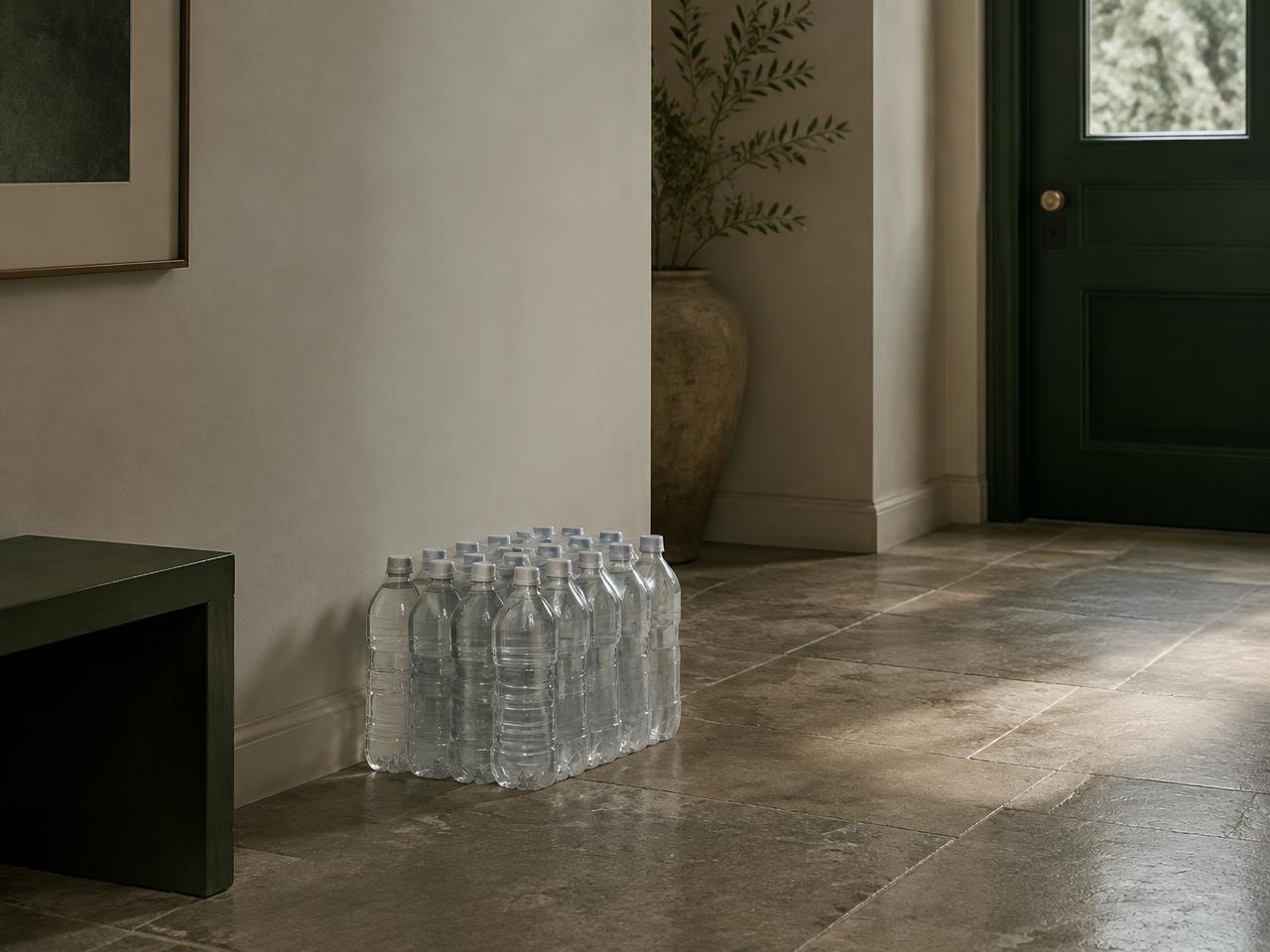
- Choose tap water instead of water in plastic bottles. That also cuts down on a lot of packaging waste.
- Do not leave bottles in the sun or in a hot car.
- Use glass or stainless steel for water that needs to be stored for a long time.
What about a filter? The Aqualine’s ceramic pre-filter has pores measuring 0.2 micrometers (0.0002 millimeters). Particles larger than that are blocked. We do not (yet) have a separate lab test for microplastics, so we are not making any statements about them.
Sources
This article is for informational purposes only and is not a substitute for medical advice. Last reviewed: November 2026.
Would you rather stop using plastic bottles?
With an Aqualine, you can filter your tap water at home—without electricity and without having to lug around bottles.
See also