
New: the Aqualine NXT — come see it at the Therapists' Fair in Houten on November 21 & 22. Discover the NXT →
Filtering water the way nature does.
You pour tap water into the upper tank. Gravity does the rest: the water slowly trickles through a ceramic filter and a multi-stage filter, rests on mineral stones, and comes out fresh from the spout. No electricity, no plumbing, no wastewater. Every Aqualine works this way; only the size of the tank differs.
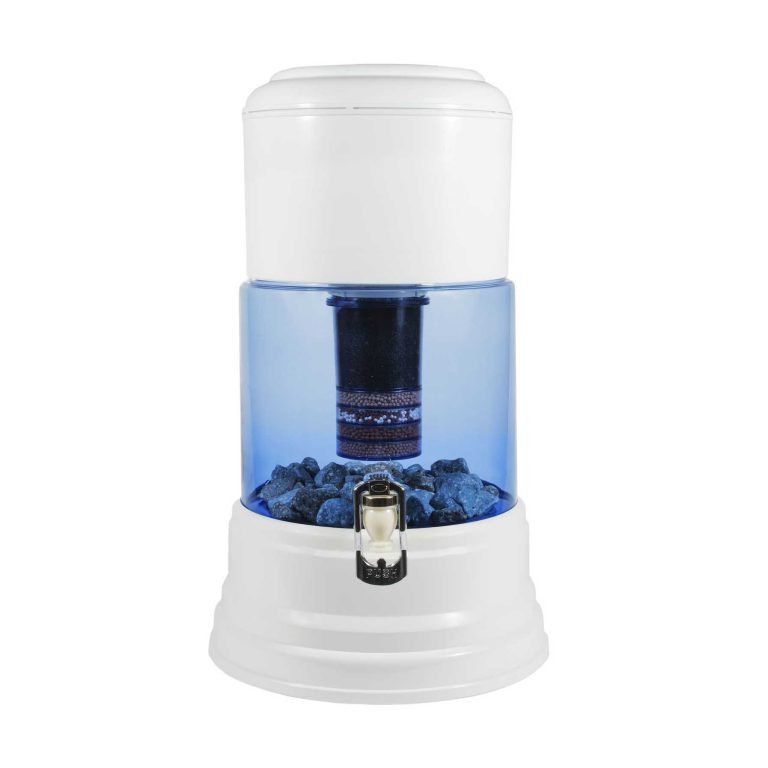
Spring water becomes clear and rich in minerals as rainwater slowly seeps through the soil. The Aqualine follows that same path—but right on your kitchen counter.
Because everything relies on gravity, the Aqualine filters slowly: about 1 liter per hour. It is precisely this slow pace that gives the water time to pass through each layer.
Click on a step or a number in the photo to view that section.
Just pour tap water into the upper tank. No electricity or water connection is needed. So you can place the Aqualine anywhere. Just be careful of direct or indirect sunlight, as it can cause algae to grow.
The white sphere has pores up to 0.2 microns (0.0002 mm) in size. Anything larger than that cannot pass through.
The water then flows down through a tube consisting of several layers. Each layer has its own function.
The ring beneath the multi-stage filter slowly releases minerals, including calcium and magnesium. This causes the water's pH to rise slightly. The pH-neutral version does not include this ring, so the pH remains unchanged.
Replace: annuallyIn the storage tank, the filtered water rests on natural mineral stones. These mineral stones ensure fresh, flavorful water. The brown stones have been treated with silver and inhibit bacterial growth in the standing water.
Replace: every 3 yearsThe faucet contains four magnets that cause the water to swirl even more when you turn it on, just like water swirling over rocks in a stream. After that, it’s ready to drink, to make coffee or tea, or to use for cooking.
Belgian tap water is of good quality. However, it may contain traces of substances you’d rather not drink, and old pipes can release particles.
The Aqualine is not a reverse osmosis system: the water is not "stripped" of its minerals. Minerals such as calcium and magnesium remain, and the mineral stones replenish trace elements.
In laboratory testing, the removal rate exceeded 99% for each substance tested.
The filtering process is the same for both: the same filters remove the same substances. The difference lies in what happens to the water afterward.
The water is filtered and rests on the mineral stones. The pH remains roughly the same as that of your tap water.
A pH ring releases additional minerals, including calcium and magnesium, causing the water's pH to rise slightly.
Tip: It's best to keep the collection tank half-full, rather than draining it completely every time.
Filters become saturated over time. Replacing them at regular intervals keeps them working just as well as they did on day one.
All three filter in the same way. Choose based on how much water you use each day.
Storage tank · 1–2 people. Made of glass or ABS.
Check out the Aqualine 7 →Storage tank · 2–3 people. Made of glass or ABS.
Check out the Aqualine 12 →Storage Tank · 4 or more people. Made of glass.
Check out the Aqualine 18 →Not sure? Take the selection guide: two questions and you’ll know which Aqualine is right for you. Prefer not to refill? Check out the Aqualine WP-100 , which connects directly to the water supply.
About 1 liter per hour. New filters are slightly slower at first because they need time to become saturated. So feel free to top off the upper tank in the evening—that way, you’ll have a full collection tank in the morning.
Microplastics are plastic particles smaller than 5 mm. The ceramic filter traps particles larger than 0.2 micrometers.
Over time, the pores of the ceramic filter and the activated carbon in the multi-stage filter become clogged. It is not possible to clean them thoroughly enough to reuse them safely, so you should replace them at regular intervals.
In an emergency, yes. First, pour the water through a tea towel folded in half, and keep in mind that the filters will clog more quickly: replace them after about 600 to 700 liters.
No. Reverse osmosis removes almost everything from the water, including the minerals, and requires electricity and a drain. The Aqualine uses gravity to filter the water and leaves the minerals in it.
Just add tap water; the Aqualine will take care of the rest.